
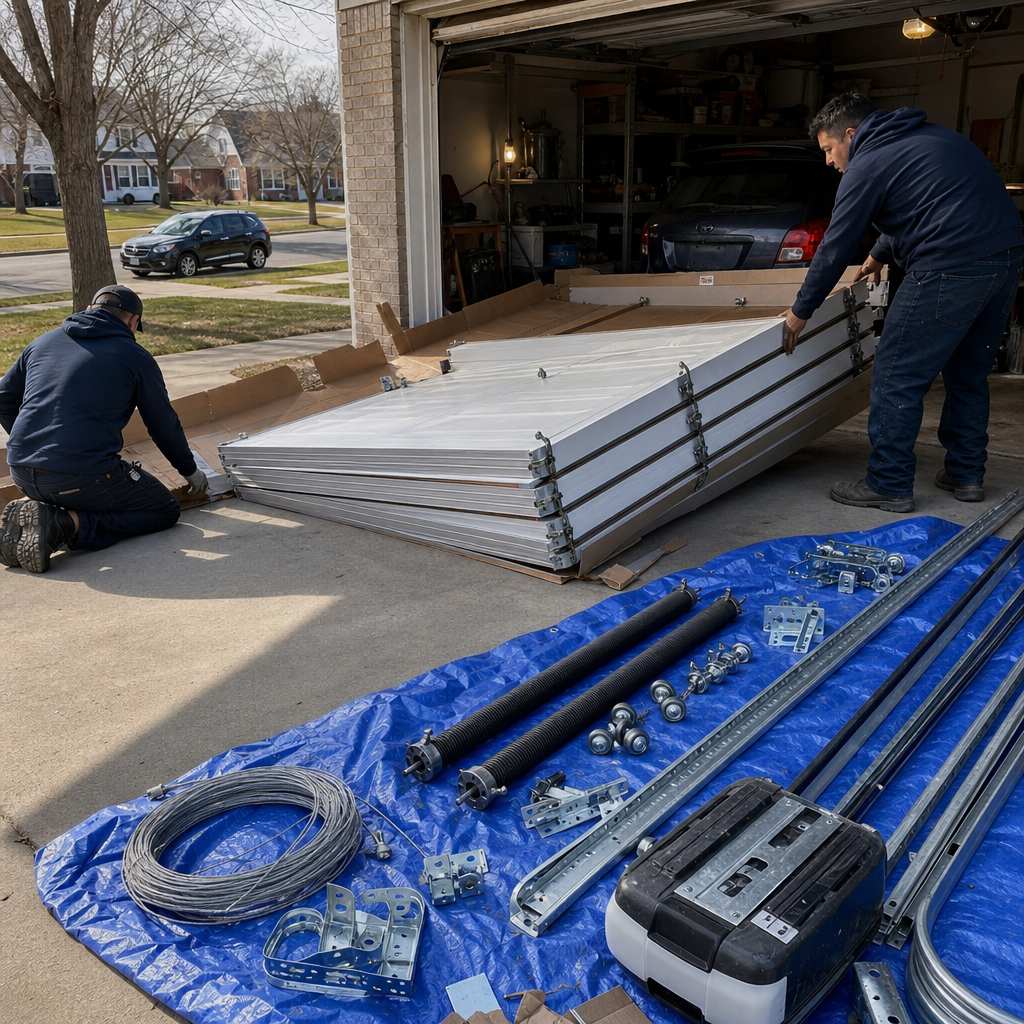
Raynor Roller Replacement: The Chicago Owner’s Guide
Raynor roller replacement in Chicago typically runs $110-$220 installed, and we stock the common sizes on every truck so most jobs finish in one visit. We carry both OEM Raynor rollers and quality equivalents that meet the same 6200-series bearing spec, which matters more than the box label. If your door is shaking, squealing, or hanging crooked in the track, worn rollers are usually the cause.
Most Chicago homeowners notice roller trouble when the door starts sounding like a train car on the Brown Line at 6 a.m. The rollers take the full weight of your door every time it moves, and after fifteen or twenty years of Chicago freeze-thaw cycles, the bearings dry out and the wheels flatten or crack. In neighborhoods like Portage Park and Beverly, we see a lot of original Raynor rollers from the 1990s and early 2000s finally giving out.
Which Raynor Models This Applies To
Raynor has used several roller configurations across their residential lines, and matching the right one prevents the door from binding or jumping track. The most common are the 2-inch and 3-inch stem lengths, with 2-inch rollers standard on Raynor Admiral, Ambassador, and Pilot series doors from roughly 1995 to 2015. Newer Raynor Distinction and BuildMark doors often ship with 3-inch stem rollers to accommodate thicker track hardware.
The critical spec is the roller diameter: 2-inch rollers for standard 2-inch track, 3-inch rollers for heavy-duty or commercial-grade track. Raynor’s OEM roller uses a sealed 6200-series ball bearing, but we also install premium aftermarket rollers with the same bearing spec and a 10-ball nylon tire that runs quieter on steel track. You can identify your roller by pulling one and checking the stem length, or by finding the Raynor model sticker on the inside top edge of the door section. If the sticker is gone, measure the stem from the roller wheel to the end of the shaft. Mainspring Garage Door Co. of Chicago is an independent service provider, not affiliated with Raynor, but we have worked on enough of their doors to know the part numbers by sight.
Signs Your Raynor Roller Replacement Is Failing
- The door shakes or vibrates when opening or closing. This happens when the roller bearings have worn to the point of slop in the wheel. The roller no longer rolls; it skids and chatters against the track, and that vibration travels through the entire door system.
- You hear a rhythmic squeal or grinding noise, especially in cold weather. The sealed bearing has dried out or cracked, and metal is rubbing on metal. In Chicago, this gets worse in January when grease thickens and old bearings seize partially.
- The door hangs crooked or one side moves faster than the other. A flat-spotted or cracked roller cannot roll smoothly, so that side of the door drags. Left alone, this puts uneven stress on the cables and can throw the door off track.
- Roller wheels look cracked, chipped, or flattened on one side. Nylon tires degrade with age and UV exposure, even on a door that faces north. In South Chicago and along the lakefront, we see this more often on doors with western exposure where afternoon sun hits the garage.
- The door feels heavy or the opener strains to lift it. Bad rollers increase friction dramatically. Your opener is doing the work the rollers should be doing, which shortens the opener’s life and can trip the safety reverse if the load spikes.
Replacement Cost & What’s Included
Raynor roller replacement in Chicago runs $110-$220 for a standard residential door, which covers ten to twelve rollers, labor, and disposal of the old parts. A single-car door with ten rollers typically falls at the lower end; a double-wide or custom height door with fourteen or more rollers moves toward the higher end. If the track itself is bent or the brackets are loose, we fix that too and tell you before the work starts.
We quote the price flat before the work starts. That is the whole policy. Every roller replacement carries our 90-Day Done Right Promise in writing. If a roller fails or the door does not run right, we come back at no charge. No paperwork battle, no voicemail tag. We also offer a permanent 5% discount for seniors and veterans, and $50 off any repair over $250.
DIY or Call Us?
A homeowner can safely look, listen, and measure. Pull the emergency release, lift the door manually, and feel for rough spots or hear for grinding. You can check the roller count and stem length with a tape measure. What you should not do is remove the bottom roller or any roller while the door is under tension. The bottom bracket is attached to the cable that holds the door’s weight, and releasing it without proper support can cause serious injury.
Replacing middle rollers on a light sectional door is within reach for a handy person with locking pliers and a helper. But most Chicago garages have limited space, uneven floors, and doors that have settled over decades. We have seen DIY roller swaps turn into bent tracks, dropped doors, and calls that come in after dinner when the car is trapped inside. If you are not certain, call (833) 436-9720. We answer live, day or night, and we stock the parts.
FAQs
Quality rollers last 15 to 20 years in Chicago’s climate, though lakefront humidity and road salt in attached garages can shorten that to 12 years. The freeze-thaw cycle is hard on nylon tires and bearing seals. If your rollers are original to a door installed before 2010, they are living on borrowed time.
No. Once a roller bearing is worn or a tire is cracked, the part is done. There is no reliable way to repack or rebuild a residential garage door roller. Replacement is the only fix that lasts. Call (833) 436-9720 for an exact count and quote, estimates are free.
Most residential roller swaps take 45 minutes to 90 minutes, depending on roller count and whether the track needs adjustment. We complete the vast majority in a single visit because our trucks carry the common sizes. Dennis Kowalski has been doing this long enough to know when a job will run short and when it will not, and he passes that estimate to you before the first wrench turns.
Yes. We carry 2-inch and 3-inch stem rollers with 6200-series bearings, both nylon and steel tire options, on every Chicago-area truck. For less common Raynor commercial sizes, we can source next-day if needed, but that is rare for residential work.
Ready to get your Raynor door running quiet and straight again? Call Mainspring Garage Door Co. of Chicago at (833) 436-9720. A live person will answer, day or night, and we will give you a flat price before we schedule. Most jobs finish in one visit, and every one is backed in writing for 90 days.
Written by Dennis Kowalski, Owner, Mainspring Garage Door Co. of Chicago at Mainspring Garage Door Co. of Chicago, serving Chicago and nearby areas.